Monday, 23 February 2015

Research into viral ads

Research into viral ads
 
 
Viral advertising spreads messages, ideas and associations about a brand quickly, commonly using digital technology – in many ways viral advertising relies on the consumer to pass on information with the producer either seeding videos via YouTube, Facebook, Twitter or on many other interactive digital platforms with the consumer at the point, knowingly or unknowingly spreading the communication – viral advertising spreads like a cold virus, often quickly and efficiently affecting a large number of people. With advertising, even a negative reaction to a brand communication is considered to be impacting on a potential consumer in as much they have remembered the brand. I can remember many awful adverts from years ago for brands whose name I can remember, the visual images of which I can still see in my minds eye I the same way I can remember many of the viral ‘mash-ups’ of the Cadbury’s Gorilla advert from 2007.
 
 
Viral marketing creates ‘excitement’ and anticipation using spontaneous peer-to-peer brand marketing and can also include SMS text messages, email as well as an integrated interactive online campaign. Typically viral advertising has lower production values than traditional, ‘above the line’ audio-visual and print advertising but must look credible enough to establish connotations of brand identity through house style e.g. use of characters, typography and font, diegetic and non diegetic sound, graphics etc. Viral advertising is seen as highly profitable because it has lower production values and can reach a wide audience in a very short space of time – it can also be focused and easily controllable in terms of platforms and timescales. Often viral advertising is also used to kick start a campaign with ideas about a brand spread, deliberately with the intention of creating narrative enigmas – consumers that do not understand what they see and question in terms of content are that little bit nearer to being consumers of the brand, as in the Compare the Market long running advertising campaign. This early content can be planted in blogs, articles or message board postings for example to generate ‘buzz’ and are rarely focused on the brand itself, more the ‘product image’.
 
Product image are the associations consumers (or potential consumers) make with a piece of creative advertising, however abstract e.g. using the examples above, what has a gorilla and a meerkat directly got to do with a chocolate bar or an insurance price comparison website? Creativity and simplicity is the key on behalf of the advertiser (producer) to obtaining success – get the message across swiftly. Famously in 2000 Hotmail went from next to nobody to 30 million users with the viral email advert: “Get your own free email at hotmail.com” in the early days of internet digital technology. Market research into viral advertising suggests that the top 5 reasons for passing a communication on is:
  1. To make people laugh
  2. To recommend something
  3. As part of a competition
  4. To earn you/save you money
  5. As part of as perceived ‘noble’ cause e.g. a charity.


Examples of viral ads

Devil Baby Attack - promoting the film Devils Due


Monty the Penguin  - John Lewis


Real Beauty Sketches - Dove


How it feels through Google glass - Google

Analysis of a film poster

Analysis of a film poster
 
The Eye:
 
 Although this film poster aims at a different audience with a different genre, our final poster is hoping to have a similar outcome to this one. The main focus of the poster is the eye, which suits well as it matches the film name. It takes up majority of the page and has been edited to give an eerie feel to it. The iris has been edited red in colour, to give connotations of blood due to it being a horror film. The rest of the eye/poster is also edited to give it shadows and a more dull sinister feel. To add to the horror, there are fingers crawling out of the eye to make the whole poster more creepy. This is something we similarly want to achieve with out poster, minus the horror.
In our film, we have an extreme close up shot of Lola's eyes which we were going to use in our poster. We will similarly edit it to give it shadows and make the character's eyes look more interesting and appealing. In this poster, the character eye has been edited red which is something we could also copy to make the character look more dead or eerie.

The text in the poster is very simple, sticking to the bottom of the page. This makes it so there is nothing around the eye distracting you from it, making it even more prominent on the page. The title and main actors name are quite clear from first glance as these are the main interest points that the audience looks for. The rest of the information is towards the bottom of the poster, not as noticeable as the rest of it. This is to not draw away the focus from the eye as posters are usually viewed as someone pass's by them. The word 'EYE' is written in bold and matches to the main image. It doesn't give much away about the film, which is something that the creators may have wanted to make the audience more ambiguous as to what happens within the film.
This is something we could take into consideration when making our poster. As we also want to focus it around Lola's eyes, we could also place text at a different point of the page, but make sure the title and main actors name is still in focus. This is to make the eye the main focus part of the page and to not give anything away of what happens in the film.

Overall, the poster gives off an eerie, sinister feel and captures the audience through the simple editing of the eye. This is something we will try to achieve when making our film poster so we will try to take inspiration from this one.

Friday, 13 February 2015

Film Reviews of Similar Films

The Fault In Our Stars(2014)
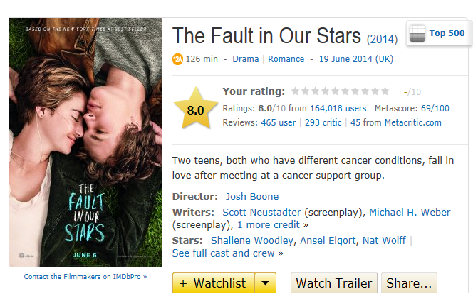
This movie is similar to our film in that it has themes of death, love, coping and adolescent life. I wanted to see if it was popular to the shared target audience we have with this film, to ensure our film would be successful with our audience.


After looking on popular film review sites such as 'IMDB' and 'Rotten Tomatoes', I found that this film had a great reception from a wide audience. IMDB rated it 8/10 and it is in the top 500 movies that are listed on the website, alongside Rotten Tomatoes who rated it 81%. It grossed $124,868,837 at the box office in the USA alone, highlighting its popularity and success.


There were hundreds of positive reviews found online by well-known critics that were all captivated by the emotional rollercoaster that this film promises to deliver. In general, it was clear that many of the critics who reviewed the film in a good light commented on the empathy that the film encouraged them to feel and how relatable the characters were, specifically to a teenage audience.


Friday, 30 January 2015

Research into Viral ads


Research into Viral Ads 


Cross media marketing is a form of cross-promotion in which promotional companies commit to surpassing the traditional advertisements and decide to include extra appeals to their offered products. The material can be communicated by any mass media such as e-mails, letters, web pages, or other recruiting sources. This method can be extremely successful for publishers because the marketing increases the ad’s profit from a single advertiser. Furthermore, this tactic generates a good liaison between the advertiser and the publisher, which also boosts the profits.

Viral marketing, viral advertising, or marketing buzz are buzzwords referring to marketing techniques that use pre-existing social networking services and other technologies to try to produce increases in brand awareness or to achieve other marketing objectives (such as product sales) through self-replicating viral processes, analogous to the spread of viruses or computer viruses ( Internet memes and memetics). It can be delivered by word of mouth or enhanced by the network effects of the Internet and mobile networks. Viral advertising is personal and, while coming from an identified sponsor, it does not mean businesses pay for its distribution. Most of the well-known viral ads circulating online are ads paid by a sponsor company, launched either on their own platform (company webpage or social media profile) or on social media websites such as YouTube. Consumers receive the page link from a social media network or copy the entire ad from a website and pass it along through e-mail or posting it on a blog, webpage or social media profile. Viral marketing may take the form of video clips, interactive Flash games, advergames, ebooks, brandable software, images, text messages, email messages, or web pages. The most commonly utilized transmission vehicles for viral messages include: pass-along based, incentive based, trendy based, and undercover based. However, the creative nature of viral marketing enables an "endless amount of potential forms and vehicles the messages can utilize for transmission", including mobile devices.


According to marketing professors Andreas Kaplan and Michael Haenlein, to make viral marketing work, three basic criteria must be met, i.e., giving the right message to the right messengers in the right environment:
  1. Messenger: Three specific types of messengers are required to ensure the transformation of an ordinary message into a viral one: market mavens, social hubs, and salespeople. Market mavens are individuals who are continuously ‘on the pulse’ of things (information specialists); they are usually among the first to get exposed to the message and who transmit it to their immediate social network. Social hubs are people with an exceptionally large number of social connections; they often know hundreds of different people and have the ability to serve as connectors or bridges between different subcultures. Salespeople might be needed who receive the message from the market maven, amplify it by making it more relevant and persuasive, and then transmit it to the social hub for further distribution. Market mavens may not be particularly convincing in transmitting the information.
  2. Message: Only messages that are both memorable and sufficiently interesting to be passed on to others have the potential to spur a viral marketing phenomenon. Making a message more memorable and interesting or simply more infectious, is often not a matter of major changes but minor adjustments.
  3. Environment: The environment is crucial in the rise of successful viral marketing – small changes in the environment lead to huge results, and people are much more sensitive to environment. The timing and context of the campaign launch must be right.


Examples of viral ads 


Issues encountered during editing


Issues Encountered During Editing


During the editing process we came across many issues that we had to mend. Such issues like our monitor and the software closing down so therefore we would have to re do all the work that had been deleted. This became frustrating for us as a group because it wasnt our fault, there was a fault in the monitor itself but because our film was so far ahead and all the work had been saved on to that computer it wouldve been risky to solve the problem on the monitor just incase everying got erased so instead we had to just save our work everytime we would change or add something as the monitor would shut down unexpectedly. 
We all came across issues such as realising that there were some shots missing or that needed to be added on so that there would be continuity in our film, we realised there were shots missing once we had put all the shots together so therefore we had to go out and do those shots. Also when editing we would realise that some props places had changed in some shots or the characters costume would look different so we had to redo those shots again,
Durig the filming procedure we filmed our shots in random order depending on which location we were filming in first and because of that while editing we came across problems such as the time of day, as one shot would be dark because it was shot in the winter afternoon and another shot would be sunny and because of this we had to edit those shots and change the colour format to not make it seem that obvious.
One big issue that we came across once our rough copy was done and posted on youtube, was that we realised 2 shots were not in focus however it had looked focused on the software before we posted it out so now we're going to re shoot those two shots to create a successful film.

Analysis Of A Film Poster.


This is the original movie poster for 2014 Drama film Gone Girl. Although impressive, the poster does not disclose much information about the film and is quite ambiguous. I feel this is done intentionally, as the title of the film suggests that a female character has gone missing. This indicates a theme of mystery which may be incorporated in the film, which the film may not want to give away.

The majority of the poster visually shows a large photograph of the sky, with some landscape showing underneath. The man in the middle of the picture is presumably in his late 20's. It is hard to tell by his facial expression how he is feeling, but it is assumed that he is worried. We know that he will have some relationship with the missing girl, as he must be a main character due to his single appearance on the poster. We could assume that it would be his wife, due to his age and the slogan 'you don't know what you've got till its...' which suggests he did not appreciate his marriage before his wife's disappearance. The audience may either sympathise with the character or due to the tagline, feel that he may be responsible or involved in the disappearance.

There is a semi transparent image of a pair of eyes which can be seen in the sky. Eyes often indicate emotion which suggests the film will involve many moving and touching moments. This also adds a mysterious effect as it is unclear who's eyes they are. We can also see a bar at the lower end of the poster, which appear to be information bars which we often see along the bottom of the television when we watch the news. This indicates that the disappearance of his wife will make national (or maybe international) news. This suggests that her disappearance may involve murder or something of a serious nature. This creates empathy and distress in the audience for the missing girl.

This poster is influential when it comes to our media group considering what our poster should look like. There is a shot in our film of an extreme close up of Lola's eyes which could be incorporated in our poster in a similar way to this one. I also feel that the poster for our film should also be quite ambiguous to avoid giving away any plot twists that our film contains and also add to the mystery of the film. When our audience sees our film poster, we would like them to feel intrigued to watch the film despite not knowing the movies full contents. I feel that this poster is successful in achieving this in their target audience.

LOLA rough cut export


Here is our very rough copy of our film LOLA.