Showing posts with label Demi Cash. Show all posts
Showing posts with label Demi Cash. Show all posts
Tuesday, 14 April 2015


Monday, 13 April 2015
Question 1 - Evaluation
1) In what ways does the media product use, develop or challenge forms and conventions of real media products?

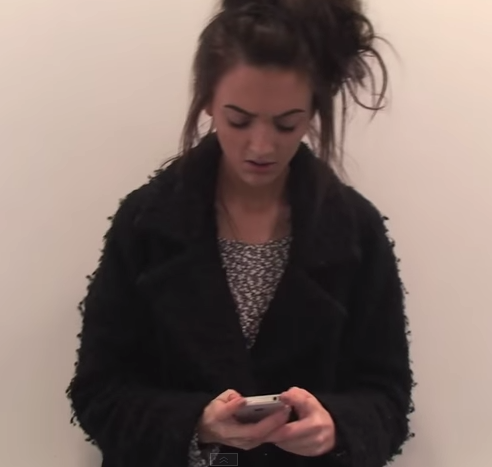
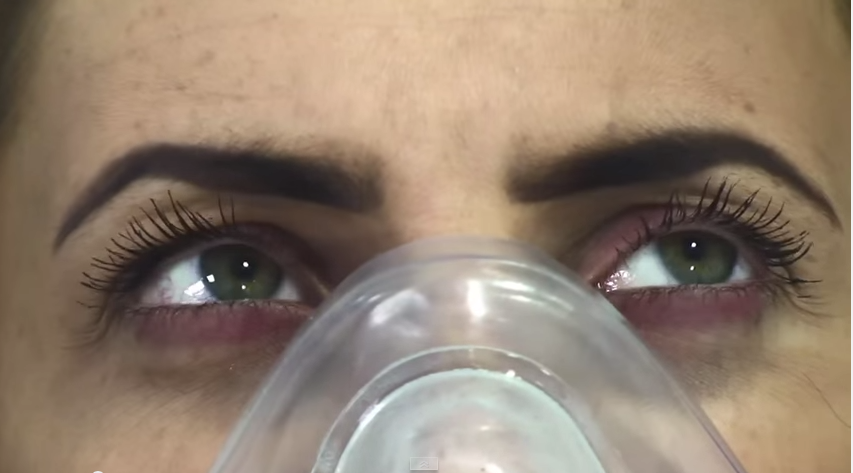 Our film both supports and subverts the media conventions of a melodrama. We stuck to key themes of the genre we wanted our film to be so our audience were familiar with what to expect from the film in the first couple of minutes. We did this in the title sequence by showing vague flashes of clips from a hospital related scene accompanied with sad piano music, to indicate the conventions of the film from the beginning whilst keeping the audience intruigued by not giving away too much of the storyline. Levi Strauss' theory of binary opposites was represented in our film throughout, with conflicting moments of happiness/sadness to keep our audience entertained and 'on edge'. We also ensured that our teenagers were stereotypical as it had to be ensured that our audience would empathise with the tragedy of our characters, and to do this we had to make sure our audience was constantly familiar with the youth of the characters. We made sure they appeared as teenagers by using slang terms, wearing fashionable clothing and constant use of mobile phones.
  However, there were moments in our film that went beyond the expectations of the conventions of a melodrama. In drama related films, there is usually a sense of resolution and satisfaction at the end. Our film ends on a total cliffhanger, meaning the audience would have to come to their own conclusions on how the characters handled their new found circumstances.
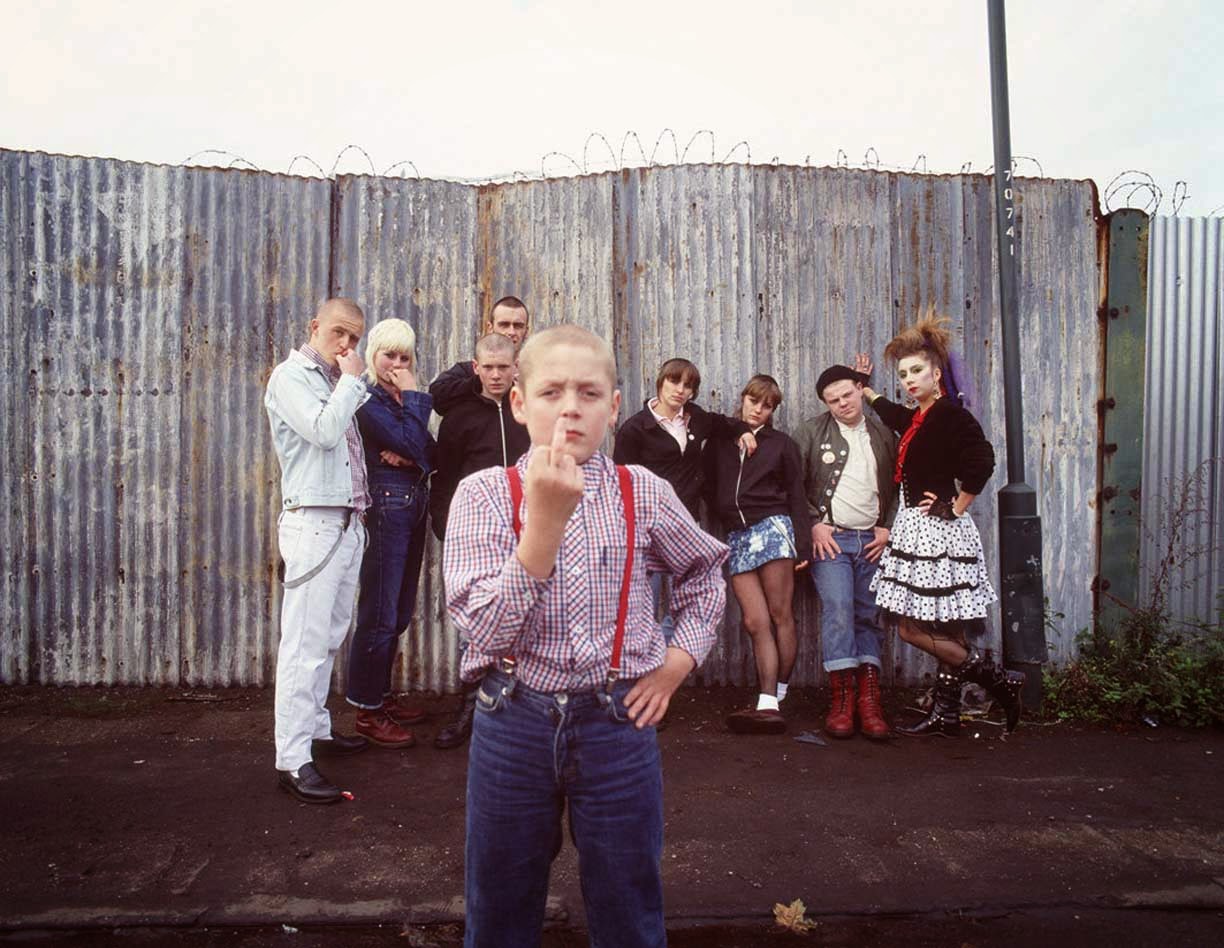 We did not add 'parody' to the film deliberately, however we could say we used elements of pastiche in our film with the narrative being displayed from a deceased persons perspective - An idea which is similarly portrayed in the film Lovely Bones. However this general idea spiraled into our own imaginative and creative plot ideas - ones we developed ourselves to create a completely original and distinctive piece of film. We also wanted to give it a 'Northern' and 'Local' feel to it similar to the one portrayed in This Is England, so we kept our accents and recorded our film in scenes nearby where we live.
  We wanted to be successful in ensuring that our audience were not sure of Lola's death until the climax of the film. However, we placed subtle hints throughout the film to give them that idea, so they were intrigued to see if their ideas of the film were right or not. Hints include Lola's parents being unresponsive, unanswered phone calls, etc. We were only sure that we were successful on this after hearing feedback of others. All though many people started to question whether she was still alive, nobody was sure until the very end. This helped us recognize that we had achieved delivering suspense to our audience which was something we were determined to do from the start.
  We also left the film on a cliff hanger to give the audience a chance to reflect themselves on the film and what they thought would happen. This way they get to decide their own ending to the film, whether that be a positive or negative one. This also allowed us to see whether we had left people eager to see more, so we knew that if they wanted to know the real ending, they had been entertained by the film from start to finish.
 Friday, 13 March 2015
Final Film Questionnaire analysis

75% of the responses we got for the first question all rated our film 5 out of 5, this is great for us as a group knowing that our audience has enjoyed watching our film and they think its great quality. And for us it means we have done what we have been aiming to do, which is to please our target audience. 6.3% of the responses gave it a 4 out of 5 which is still really good, because it gives us a small negative that we will try and work on for our next project.
For the second question again we got a similar response, 12 people gave 5 for the question 'how would you rate the lighting in the film?' and the rest gave it a 4. We struggled with the lightening during the filming because of the time we would do filming during the day so the light would change constantly and that worried us, but now looking at the responses and seeing that the audience didn't acknowledge is great.
Question three which asked 'did you understand the storyline?' was a very big question as our storyline was abit complicated with a big twist at the end, and the responses we got for this question was superb, every individual that participated in this questionnaire said yes, this means that we have portrayed our film in the right manner for our audience to understand the plot and not get confused by it.
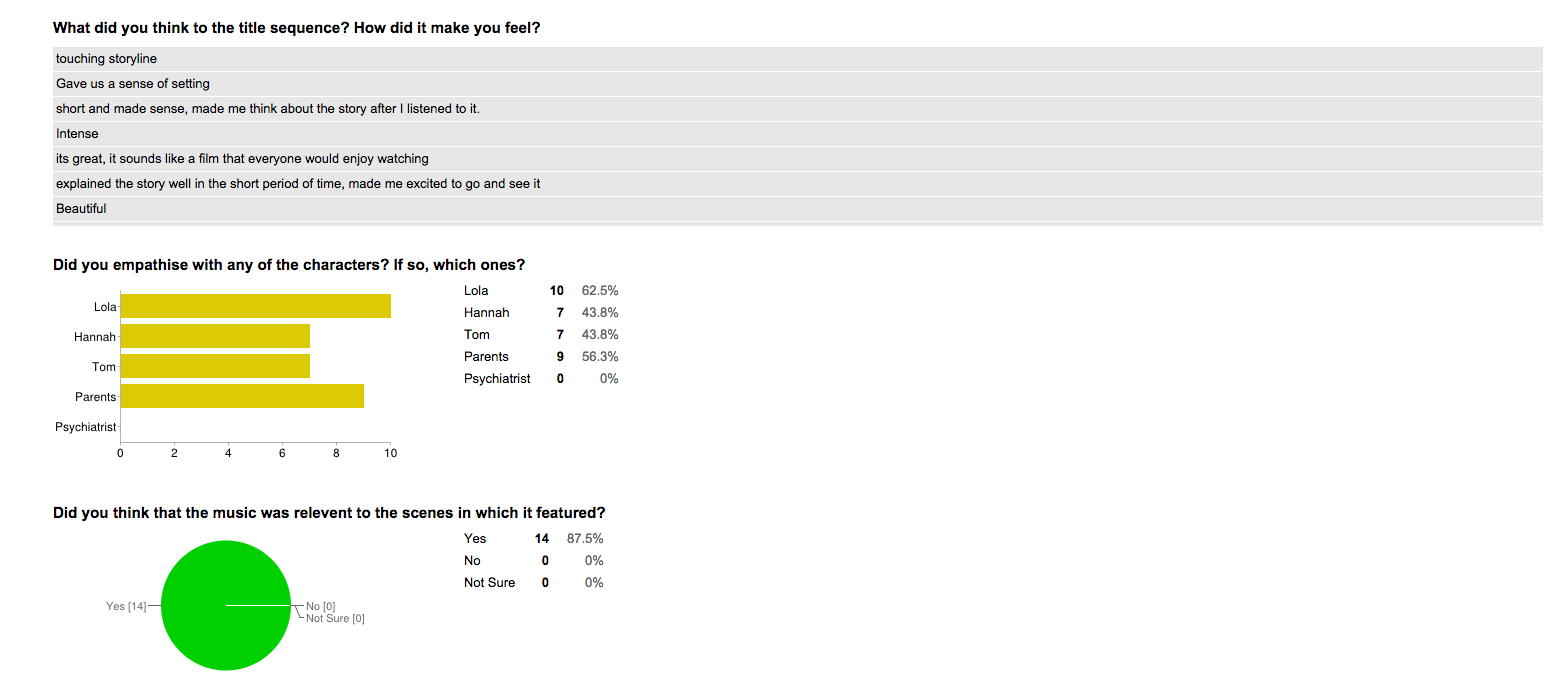
For question four we got a variety of different answers, but all the answers are very generous. This question asked the audience to give their opinion on how the title sequence made them feel, and all the answers were positive which is great because it means they have enjoyed watching it and not boring.
The fifth question got alot of mix opinions of who the audience sympathised with, most people chose Lola and the parents, which makes sense because we tried to make the audience have a connection with Lola from making the story from her point of view and giving her a likeable character.
Everyone said yes for the sixth question which was if the music matched the scenes, it took us a while to find suitable songs that would reflect the right emotion on the scenes and again its made us really happy looking a these responses and seeing that the audience agreed with our choices.

For the eighth question most people understood hannah's role in the film and a small percentage mostly understood which is great, because we were unsure on wether or not we portrayed her well, and the flashbacks at the end were abit confusing, so the responses were relieving knowing that the audience understood her.
Everyone say yes for the question 9, which was if they liked the cliffhanger at the end, we really struggled to portray the cliffhanger but the fact that the audience liked it and got it made us really happy knowing it was worth the struggle.

Thursday, 5 March 2015


Friday, 30 January 2015
Issues encountered during editing
Issues Encountered During Editing
We all came across issues such as realising that there were some shots missing or that needed to be added on so that there would be continuity in our film, we realised there were shots missing once we had put all the shots together so therefore we had to go out and do those shots. Also when editing we would realise that some props places had changed in some shots or the characters costume would look different so we had to redo those shots again,
Durig the filming procedure we filmed our shots in random order depending on which location we were filming in first and because of that while editing we came across problems such as the time of day, as one shot would be dark because it was shot in the winter afternoon and another shot would be sunny and because of this we had to edit those shots and change the colour format to not make it seem that obvious.
One big issue that we came across once our rough copy was done and posted on youtube, was that we realised 2 shots were not in focus however it had looked focused on the software before we posted it out so now we're going to re shoot those two shots to create a successful film.
Analysis Of A Film Poster.

This is the original movie poster for 2014 Drama film Gone Girl. Although impressive, the poster does not disclose much information about the film and is quite ambiguous. I feel this is done intentionally, as the title of the film suggests that a female character has gone missing. This indicates a theme of mystery which may be incorporated in the film, which the film may not want to give away.
The majority of the poster visually shows a large photograph of the sky, with some landscape showing underneath. The man in the middle of the picture is presumably in his late 20's. It is hard to tell by his facial expression how he is feeling, but it is assumed that he is worried. We know that he will have some relationship with the missing girl, as he must be a main character due to his single appearance on the poster. We could assume that it would be his wife, due to his age and the slogan 'you don't know what you've got till its...' which suggests he did not appreciate his marriage before his wife's disappearance. The audience may either sympathise with the character or due to the tagline, feel that he may be responsible or involved in the disappearance.
There is a semi transparent image of a pair of eyes which can be seen in the sky. Eyes often indicate emotion which suggests the film will involve many moving and touching moments. This also adds a mysterious effect as it is unclear who's eyes they are. We can also see a bar at the lower end of the poster, which appear to be information bars which we often see along the bottom of the television when we watch the news. This indicates that the disappearance of his wife will make national (or maybe international) news. This suggests that her disappearance may involve murder or something of a serious nature. This creates empathy and distress in the audience for the missing girl.
 This poster is influential when it comes to our media group considering what our poster should look like. There is a shot in our film of an extreme close up of Lola's eyes which could be incorporated in our poster in a similar way to this one. I also feel that the poster for our film should also be quite ambiguous to avoid giving away any plot twists that our film contains and also add to the mystery of the film. When our audience sees our film poster, we would like them to feel intrigued to watch the film despite not knowing the movies full contents. I feel that this poster is successful in achieving this in their target audience.
Monday, 26 January 2015
Research into editing techniques
Research into editing techniques
EDITING
Editing describes the relationship between shots and the process by which they are combined. It is essential to the creation of narrative space and to the establishment of narrative time. The relationship between shots may be graphic, rhythmic, spatial and/or temporal.
Filmmakers and editors may work with various goals in mind. Traditionally, commercial cinema prefers the continuity system, or the creation of a logical, continuous narrative which allows the viewer to suspend disbelief easily and comfortably. Alternatively, filmmakers may use editing to solicit our intellectual participation or to call attention to their work in a reflexive manner.
Filmmakers and editors may work with various goals in mind. Traditionally, commercial cinema prefers the continuity system, or the creation of a logical, continuous narrative which allows the viewer to suspend disbelief easily and comfortably. Alternatively, filmmakers may use editing to solicit our intellectual participation or to call attention to their work in a reflexive manner.
Graphic Match
Graphic matches, or match cuts, are useful in relating two otherwise disconnected scenes, or in helping to establish a relationship between two scenes. By ending one shot with a frame containing the same compositional elements (shape, color, size, etc.) as the beginning frame of the next shot, a connection is drawn between the two shots with a smooth transition.
The first clip below, from Hitchcock’s Psycho, takes place just after a woman is brutally stabbed to death while in the shower. As her blood washes away down the drain with the water, the camera slowly zooms in on just the drain itself. A graphic match cut is then utilized, as the center of the drain becomes the iris of the victim’s lifeless left eye.
Rhythm
Rhythm editing describes an assembling of shots and/or sequences according to a rhythmic pattern of some kind, usually dictated by music. It can be narrative, as in the clip from Woody Allen’s Bananas below, or, a music video type collage, as in the second clip from Sofia Coppola’s Marie Antoinette. In either case, dialogue is suppressed and the musical relationship between shots takes center stage.
In Allen’s Bananas, the use of a vaudeville-esque tune recalls Charlie Chaplin and early cinematic comedy. Like Chaplin’s characters, Fielding Melish’s actions and adventures continually result in humorous misadventure. In the sequence below, he heroically expels two thugs from a subway car. The length of the shots is determined by the quick tempo of the piano recording: as the villains’ abuse of innocent passengers reaches a climax, the shots become shorter and shorter. The quick editing builds suspense before the hero unpredictably rises and throws them off the train.
Establishing Shot
The Establishing Shot or sequence serves to situate the audience within a particular environment or setting and/ or to introduce an important character or characters. The establishing shot is usually the first or the first few shots in a sequence, and as such, it must be very efficient in portraying the context. Typically, establishing shots are Extreme Long Shots or Long Shots, followed by progressively closer framing.
Quentin Tarantino introduces his film Inglorious Basterds, with an extreme long shot of the countryside, suggestive of rural France. It is followed by a medium shot of the dairy farmer, who will dominate the first scene. One of the man’s daughters is also shown, first in a medium shot and then in medium close-up, hanging clothes. Moreover, the sequence establishes the central conflict, with the arrival of the German motor cars, shown in POV shots from the perspective of the farmer and his daughter.
Shot/ Reverse Shot
Shot/Reverse Shot is an editing technique that defined as multiple shots edited together in a way that alternates characters, typically to show both sides of a conversation situation. There are multiple ways this can be accomplished, with common examples being over the shoulder shots, angled shots, left/right alternating shots, and often a combination of the three.In the first clip below, from Terry Zwigoff’s Bad Santa, we see a standard over the shoulder SRS. This, combined with eye-line matches between the two main negotiators shows how focused each is on the other. The over the shoulder technique allows the viewer to see the facial expressions of each character while listening or speaking. More importantly, the over the shoulder technique creates a sense of space between the characters greater than the actual distance between them. This keeps the frame from being uncomfortably cramped, and also shows the distance between the characters’ different standpoints.
Eye-line Match
In an eye-line match, a shot of a character looking at something cuts to another shot showing exactly what the character sees. Essentially, the camera temporarily becomes the character’s eyes with this editing technique. In many cases, when the sequence cuts to the eye-line, camera movement is used to imply movement of the character’s eyes. For example, a pan from left to right would imply that the character is moving his/her eyes or head from left to right. Because the audience sees exactly what the character sees in an eye-line match, this technique is used to connect the audience with that character, seeing as we practically become that character for a moment. Each of the following sequences is from No Country For Old Men, directed by the Coen Brothers.In the first clip, five eye-line matches are shown in a sequence that’s only a minute long. The first of these contains movement from left to right, mocking Llewelyn’s motion as he walks up to the dead body. We then see relatively still eye-line matches as Llewelyn looks at man’s face, and then at the gun as he picks it up. The next eye-line match is shown as Llewelyn opens the briefcase of money, which contains a slight zoom. This zoom is not necessarily used to mimic Llewelyn’s eye movement, but rather his thought and emotion, as the sight of all the money understandably “brings him in.” The Coen brothers decided to use so many eye-line matches in this sequence and in the rest of Llewelyn’s journey so that the audience would come closer to experiencing what he was experiencing.
Cut-in and Cut-away
This sequence, taken from Tarantino’s Sukiyaki Western Django (2007) provide an examples of the cut-in. Cut-out or away is the reverse, bringing the viewer from a close view to a more distant one. The sequence opens with an extreme long shot of the area’s landscape, a high-angled tracking shot (probably via helicopter) –giving us a wide panoramic view of the area. A cut suddenly transports the viewer somewhere within the landscape to a medium shot of character lying on the floor in his room.Continuity editing: The Match on Action
Match on Action is an editing technique used in continuity editing that cuts two alternate views of the same action together at the same moment in the move in order to make it seem uninterrupted. This allows the same action to be seen from multiple angles without breaking its continuous nature. It fills out a scene without jeopardizing the reality of the time frame of the action.In the first scene above, Peter Jackson uses matches on action to give the chase a sense of dynamism. The viewer can never assume what is going to happen next, as the scene is constantly shifting. He uses a very complex version of match on action, jumping from close ups to far away helicopter shots and back without a pause. It is almost dizzying, yet thrilling at the same time. Be sure to keep your eye on the white horse; this is the character we are following and although hard to see at times it is present in every part of the clip.
Parallel Editing
Parallel editing is a technique used to portray multiple lines of action, occurring in different places, simultaneously. In most but not all cases of this technique, these lines of action are occurring at the same time. These different sequences of events are shown simultaneously because there is usually some type of connection between them. This connection is either understood by the audience throughout the sequence, or will be revealed later on in the movie. The first clip is from No Country For Old Men directed by the Coen Brothers, and the second is from Batman: The Dark Knight directed by Christopher Nolan.In this first clip, we see parallel editing used primarily to add suspense to the situation. At first, the intervals between showing Lewelyn and Anton are relatively long, but as they shorten later on in the sequence, additional suspense is added. Just as we see in the previous clips from the film, there are many eye-line matches shown for both of the characters. This combination of parallel editing and eye-line matches for each line of action allows the viewer to practically experience both sides of the event first-hand.
Alternative transitions
Superimposition
Th following sequence is an example of superimposition. Superimposition refers to the process by which frames are overlapped, either mechanically or digitally, in order to achieve a layered transition. Japanese cinema sometimes uses traditional “kanji” calligraphy superimposed over standard film in several ways; the first of these being to illustrate a famous quotation or religious koan (a phrase chanted to bring about enlightenment), such as this example in which Tarantino says the Japanese proverb, “life is all about goodbyes” (サヨナラだけが人生だ) with the same words superimposed over the screen.Fade -in
In this sequence from Sukiyaki Western Django, the calligraphic message provides an example of the fade-in. The style used in “Sukiyaki Western Django” is reminiscent of filmmakers such as Kurosawa, who used this archaic writing technique to embed a sort of traditionalism into his media. All in all, this effect has the added value of reminding us that though we are watching a Western, there is a Japanese component that underlies all the events of the film, and we cannot forget this in sight of the lush mise en scène that encompasses the entirety of the piece.ALTERNATIVES TO THE CONTINUITY SYSTEM
In-Camera Editing
Long Take
Long takes are simply shots that extend for a long period of time before cutting to the next shot. Generally, any take greater than a minute in length is considered a long take. Usually done with a moving camera, long takes are often used to build suspense or capture the attention of audience of without breaking their concentration by cutting the film.The opening scene from Robert Zemeckis’ Forrest Gump follows a feather blowing carefree in the wind, eventually landing on the foot of the protagonist who proceeds to pick it up and place it in his suitcase. This scene acts as a metaphor for the whole movie, as the feather represents Forrest. Just as the feather blows around for what seems like forever, just going where the wind takes it until it eventually lands in a safe place, Forrest seems to just blow aimlessly through life, going wherever life and fate may take him with out too much consideration of his own, until he eventually lands in a happy place.
Jump-Cut
A Jump-Cut is an example of the elliptical style of editing where one shot seems to be abruptly interrupted. Typically the background will change while the individuals stay the same, or vice versa. Jump-cuts stray from the more contemporary style of continuity editing where the plot flows seamlessly to a more ambiguous story line. An example of this editing style can be found in the following clips from Capote (2005).
Associative Editing or “Montage”
The following clip is taken from Sergei Eisenstein’s Battleship Potemkin. This unique combination of shots shows a marble lion reacting to the sailors’ rebellion in the harbor. In the context of the story, the ship opens fire on Cossack reinforcements sent to quell its revolt. Eisenstein integrates lions sculpted in various postures to suggest that all of Moscow is awakening to the people’s cause. The sequence requires the viewer to interpret, to “read” the metaphor inherent in the statues and to derive a meaning from their presence in the diegesis.Hollywood-style Montage
Montage also describes the approach used in commercial cinema to piece together fragments of different yet related images, sounds/music, often in the style of a music video. The following sequence, from Pretty Woman (1991), is an example of the hollywood style montage. The film, starring Richard Gere and Julia Roberts, shows the main character Vivienne as she transitions from a scantily-clad, unrefined hooker, into Edward’s elegant, poised and well-dressed companion. The soundtrack plays over the background as snippets of various clothing and body parts are shown. In the concluding frame of sequence, the final product, the “new Vivienne”, approaches the camera in a white, tailored outfit and a ladylike hat.
Sunday, 25 January 2015
Shooting schedule and resources
Shooting schedule
On Friday the 14th of November 2014 we began filming our title sequence. It took in total about 1 hour to produce all the shots. It wasn't necessary to re-film any of our title sequence because we were all very happy with the outcome and feel that it looked good. Below, I have attached a rough copy of our title sequence which we produced and edited by December 2nd 2014. The title sequence itself will be using in our film, however, the shots used in the opening scene will not be used as we have re-filmed the whole scene with better shots.
We first began shooting the film on the 21st of November 2014 in the Health and Social room on the 2nd floor in Barnsley college. This scene was used to film the 'hospital scene' in which Lola first wakes up and sneaks out with Hannah. The room is set out with two hospital beds and a bedside table, however, we brought our own props to make it look more like hospital to add a sense of realism to our film and ensure it looks quite professional. However, after we filmed this and watched the footage back when editing it on Final cut express, we all decided as a group that although some of the shots were really good, for example the extreme close up of the eyes, we felt that we needed to re-film the scene again to ensure that we were happy with it. We began to re-film the same scene on the 3rd of December 2014 however, we did not have enough time to complete the whole scene so we finished off the filming on Friday 12th of December 2014, we also managed to film the stairs scene on this day which took us approximately 30minutes to film. I then took the camera equipment back to my house so we could film of the home scenes over the Christmas period.

On the 2nd of January we began filming the home scenes. We planned of filming these earlier however we had some setbacks which made us unable to do so, e.g.; snow on the ground, some members of the group ill and some members of the group at work. On the 2nd we managed to film the scene at Lola's house, the scene outside Tom's house, the scene when Lola goes to Hannah's house and the flashback scenes. Due to all the unfortunate circumstances of not being able to film on any other day, we were put under pressure to get all the scenes filmed with Demi on that 1 day. This is because Demi was dying her hair from blonde to brown on the 3rd of January. Unfortunately, the wind was really bad therefore we were unable to film much outside, this is why we slightly changed the storyline so instead of Lola and Hannah arguing outside Toms, We changed it so Lola went to Toms alone and then went to Hannah's house so the confrontation between both girls could take place indoors where the sound was a lot clearer. Putting aside all the set-backs, we were able to successfully complete all the shots on that day and when watching them back, we were all very pleased.


On Friday the 14th of November 2014 we began filming our title sequence. It took in total about 1 hour to produce all the shots. It wasn't necessary to re-film any of our title sequence because we were all very happy with the outcome and feel that it looked good. Below, I have attached a rough copy of our title sequence which we produced and edited by December 2nd 2014. The title sequence itself will be using in our film, however, the shots used in the opening scene will not be used as we have re-filmed the whole scene with better shots.
We first began shooting the film on the 21st of November 2014 in the Health and Social room on the 2nd floor in Barnsley college. This scene was used to film the 'hospital scene' in which Lola first wakes up and sneaks out with Hannah. The room is set out with two hospital beds and a bedside table, however, we brought our own props to make it look more like hospital to add a sense of realism to our film and ensure it looks quite professional. However, after we filmed this and watched the footage back when editing it on Final cut express, we all decided as a group that although some of the shots were really good, for example the extreme close up of the eyes, we felt that we needed to re-film the scene again to ensure that we were happy with it. We began to re-film the same scene on the 3rd of December 2014 however, we did not have enough time to complete the whole scene so we finished off the filming on Friday 12th of December 2014, we also managed to film the stairs scene on this day which took us approximately 30minutes to film. I then took the camera equipment back to my house so we could film of the home scenes over the Christmas period.
On the 2nd of January we began filming the home scenes. We planned of filming these earlier however we had some setbacks which made us unable to do so, e.g.; snow on the ground, some members of the group ill and some members of the group at work. On the 2nd we managed to film the scene at Lola's house, the scene outside Tom's house, the scene when Lola goes to Hannah's house and the flashback scenes. Due to all the unfortunate circumstances of not being able to film on any other day, we were put under pressure to get all the scenes filmed with Demi on that 1 day. This is because Demi was dying her hair from blonde to brown on the 3rd of January. Unfortunately, the wind was really bad therefore we were unable to film much outside, this is why we slightly changed the storyline so instead of Lola and Hannah arguing outside Toms, We changed it so Lola went to Toms alone and then went to Hannah's house so the confrontation between both girls could take place indoors where the sound was a lot clearer. Putting aside all the set-backs, we were able to successfully complete all the shots on that day and when watching them back, we were all very pleased.
This picture was taken whilst filming the 'home scene' at Lola's.
On Wednesday 14th January 2015, we filmed the final scene with Tom and the psychiatrist and also we used a zoom recorder to record Tom's voice over and got all the scenes with Tom in done on that day. However, another setback occurred when filming. Demi's sister, Jade Cash who was supposed to be playing the psychiatrist was unable to participate in the film making so we was an actress short. However, at the last minute, my sister, Amy Shutt volunteered to play the psychiatrist and we managed to get it filmed that day.
On Friday 16th January 2015, we filmed the 'accident scene' where Lola walks past the accident scene on her way to Toms and also the scene where the accident took place when Hannah pushes Lola into the road and she gets hit by a car. It took us about 1 hour to film these two scenes as it began to rain so we had to take the camera somewhere sheltered until it stopped.
This a picture to show the resources we took out to film on that particular day. We have the camera and the tripod. I looked at the weather forecast and it was forecast to rain that day so we were aware therefore I brought a large golfing umbrella to protect the camera and also a UV torch to flash into Lola's face to make it look like a headlight was hitting it.
On Friday 23rd of January 2015 we completed our final bit of filming which was in the same hospital scene we filmed for the beginning of the film. We also did some extra shots in which Lola is stumbling down the corridor making her way to the hospital room, including some point of view shots. In total, it took us approximately 4 hours to complete this scene.
This week, we are focusing on editing all our shots and creating a 'rough copy' of the film by the latest Friday 30th of January 2015. Therefore, we can then share a copy of this to friends/family and ask them to suggest improvements in which we can add to our final draft.
Saturday, 24 January 2015
Behind the scenes- Filming of Lola
We have a deadline to complete a rough copy of our short film by Friday 30th January. We have filmed all the scenes we needed to so far and this week we will focus on editing it all. Throughout the filming, we have taken varies pictures/videos to show what it has been like making the film and how our teamwork has enabled us to work together and successfully complete all tasks at hand.
Makeup


Using the Camera
We have all helped to film, taking turns using the camera and consoling with each other after each shot in order to ensure we were all happy with what we had filmed. We felt confident enough to use the bigger A2 cameras last year when filing our AS video therefore we felt a lot more confident using them again this year allowing us to experiment more.


Rehearsing the shots
Due to me and Demi being in most of the shots, we didn't have to
opportunity to see how each shot would look when filming, therefore we took it in turns to act out in each frame so we all had an idea of how the shot would look when filming it for real.

Makeup
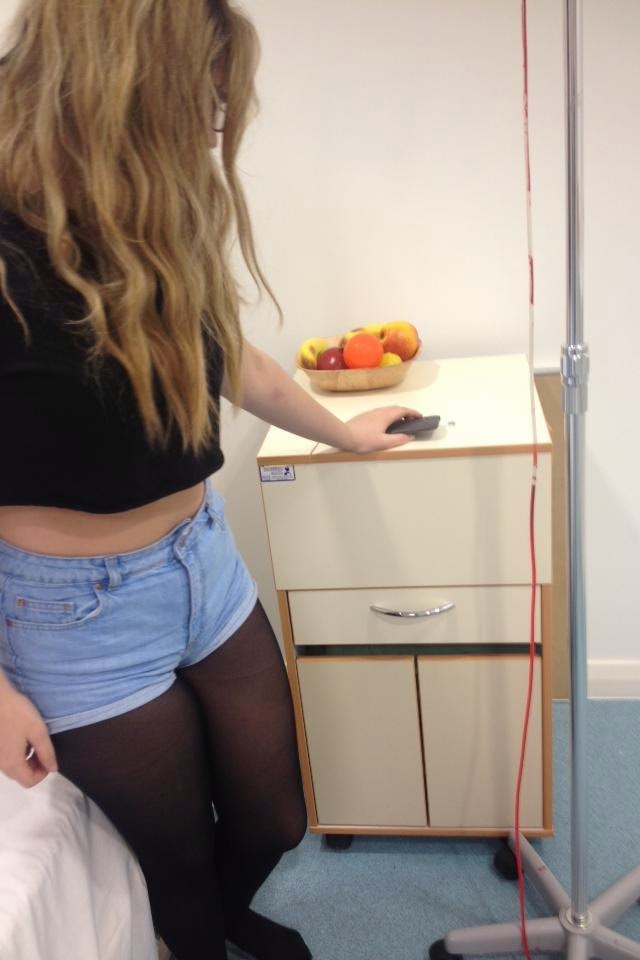
To achieve a 'unwell' look for the character Lola, Selen applied red, brown and grey eye shadow under my eyes to make them look drained and hollow. She also applied brown blusher to my cheekbones in order to exaggerate my facial shape and by enhancing the cheekbones it implied that Lola is fragile.
Using the Camera
We have all helped to film, taking turns using the camera and consoling with each other after each shot in order to ensure we were all happy with what we had filmed. We felt confident enough to use the bigger A2 cameras last year when filing our AS video therefore we felt a lot more confident using them again this year allowing us to experiment more.

Rehearsing the shots
Due to me and Demi being in most of the shots, we didn't have to
opportunity to see how each shot would look when filming, therefore we took it in turns to act out in each frame so we all had an idea of how the shot would look when filming it for real.

 |
Monday, 24 November 2014
Photo Storyboard - Title sequence
Photo storyboard - Title sequence
1) Pan up of the drip.

2) Close up shot of blood in the bowl.

3) Mid dolly shot of a nurse pushing a trolley.

4) A tilt up shot of feet in the hospital bed.

5) An establishing shot of feet walking out of the camera with a walking frame.

6) A medium shot from the waist downwards of a nurse walking through the door.

7) Same shot as before, however the nurse walks straight into the camera.

1) Pan up of the drip.
2) Close up shot of blood in the bowl.
3) Mid dolly shot of a nurse pushing a trolley.
4) A tilt up shot of feet in the hospital bed.
5) An establishing shot of feet walking out of the camera with a walking frame.
6) A medium shot from the waist downwards of a nurse walking through the door.
7) Same shot as before, however the nurse walks straight into the camera.
Tuesday, 18 November 2014
Friday, 14 November 2014
Tricky Shots
Tricky Shots
This is a video showing us attempting the tricky shots that may be included in our film.
Thursday, 13 November 2014
Short Journey
Short Journey
This is our short journey which has been cut down to show elliptical editing.
Subscribe to:
Posts (Atom)